AI in Life Sciences: Exploration and Empowerment
Artificial intelligence is becoming an active partner in the scientific method — not just automating tasks, but generating novel hypotheses and accelerating discovery across biology, drug development, and precision nutrition.
The life sciences are undergoing a fundamental shift — from hypothesis-driven research to model-driven discovery. As the AI for Science paradigm matures, artificial intelligence is not just automating tasks; it is becoming an active partner in the scientific method itself. This article divides the impact into two complementary lenses: AI for Exploration (uncovering new knowledge and generating novel hypotheses) and AI for Empowerment (amplifying existing research capabilities, efficiency, and reliability). Both dimensions are transforming biology, drug discovery, genomics, and beyond.
Part 1: AI for Exploration — Uncovering New Frontiers
Exploration-focused AI moves beyond analyzing known data to generating new scientific insights, often with minimal human bias. It embraces autonomous hypothesis formation, cross-scale modeling, and the creative synthesis of diverse biological information.
Autonomous Discovery and Hypothesis Generation
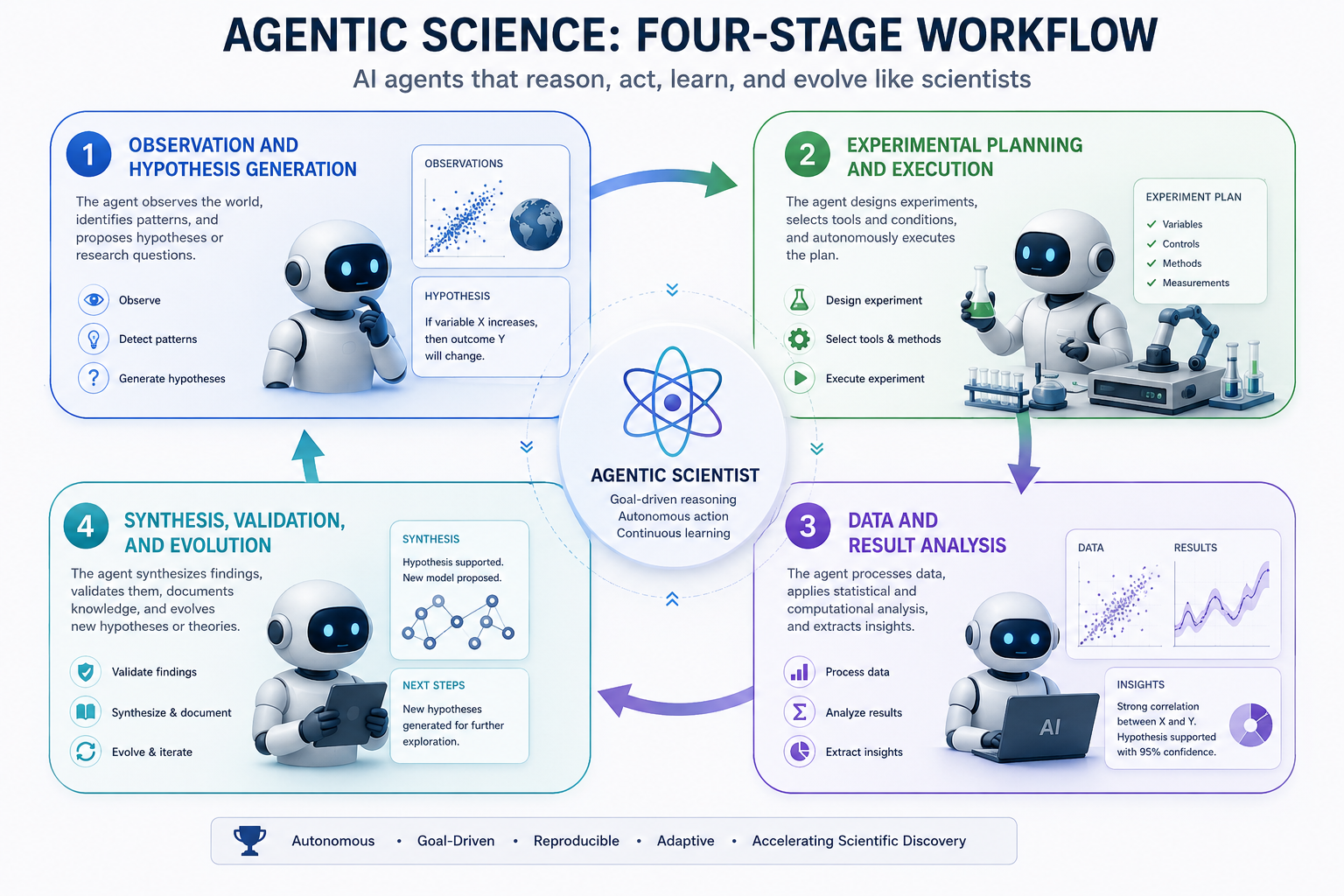
The emergence of Agentic Science marks a milestone where AI systems behave as scientific agents with goal-driven reasoning. These agents can autonomously navigate a four-stage workflow:
- Observation and hypothesis generation
- Experimental planning and execution
- Data and result analysis
- Synthesis, validation, and evolution
Current Large Language Models (LLMs) are already generating novel hypotheses by linking disparate datasets and identifying subtle patterns — potentially revealing interdisciplinary breakthroughs that humans might overlook.
Decoding Biology's Building Blocks
Tools like AlphaFold and protein structure prediction models have revolutionized structural biology, reducing years of lab work to minutes. AlphaFold3 now predicts protein interactions with high accuracy, directly enabling drug discovery and protein engineering. In genomics, deep learning uncovers variant-disease associations and guides CRISPR gene editing with improved precision.
Generative Design of Molecules and Materials
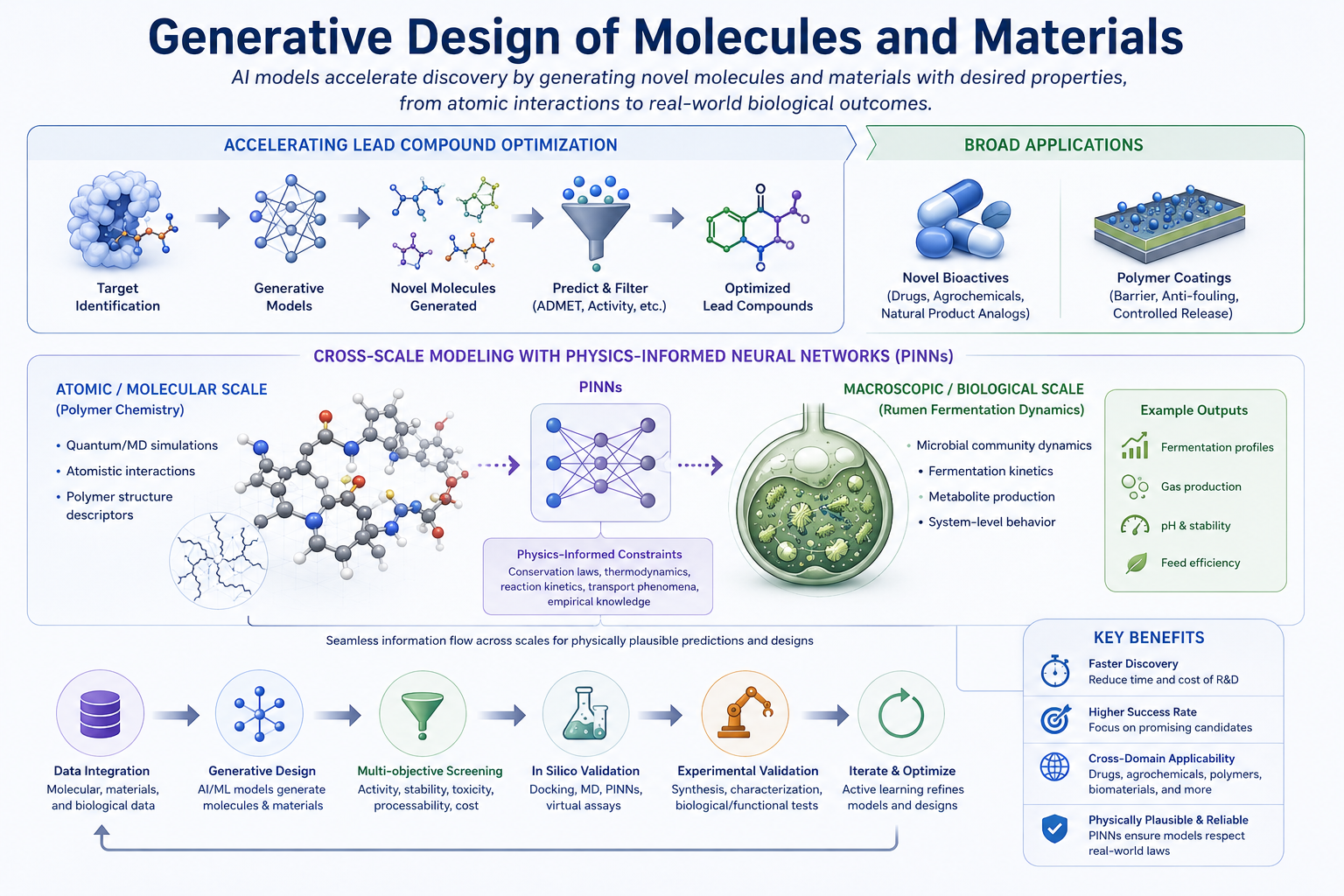
De novo molecule design leverages generative AI to create entirely new chemical entities with desired properties. These models accelerate lead compound optimization in drug discovery and can be applied to designing novel bioactives or polymer coatings. Cross-scale modeling further enriches exploration by coupling atomic-level interactions (e.g., polymer chemistry) with macroscopic biological phenomena (e.g., rumen fermentation dynamics), using physics-informed neural networks to maintain physical plausibility. These developments may also create new opportunities in agricultural biotechnology and precision livestock nutrition — an emerging area explored by companies such as Verdis Bio.
Multi-Omics and Biomarker Discovery
Multi-omics integration, powered by large language models and deep learning, enables researchers to detect novel biomarkers and understand disease mechanisms at a systems level. Unsupervised learning techniques sift through omics data to find hidden structures, while LLM-based sequence models predict functional regions in proteins and nucleic acids — opening up new research avenues in synthetic biology and personalized medicine.
Part 2: AI for Empowerment — Accelerating and Strengthening Research
Empowerment-focused AI takes existing scientific workflows and makes them faster, more reproducible, and more accessible. It enhances human capacity rather than replacing it, freeing scientists to focus on high-level reasoning.
Automation of the Research Cycle
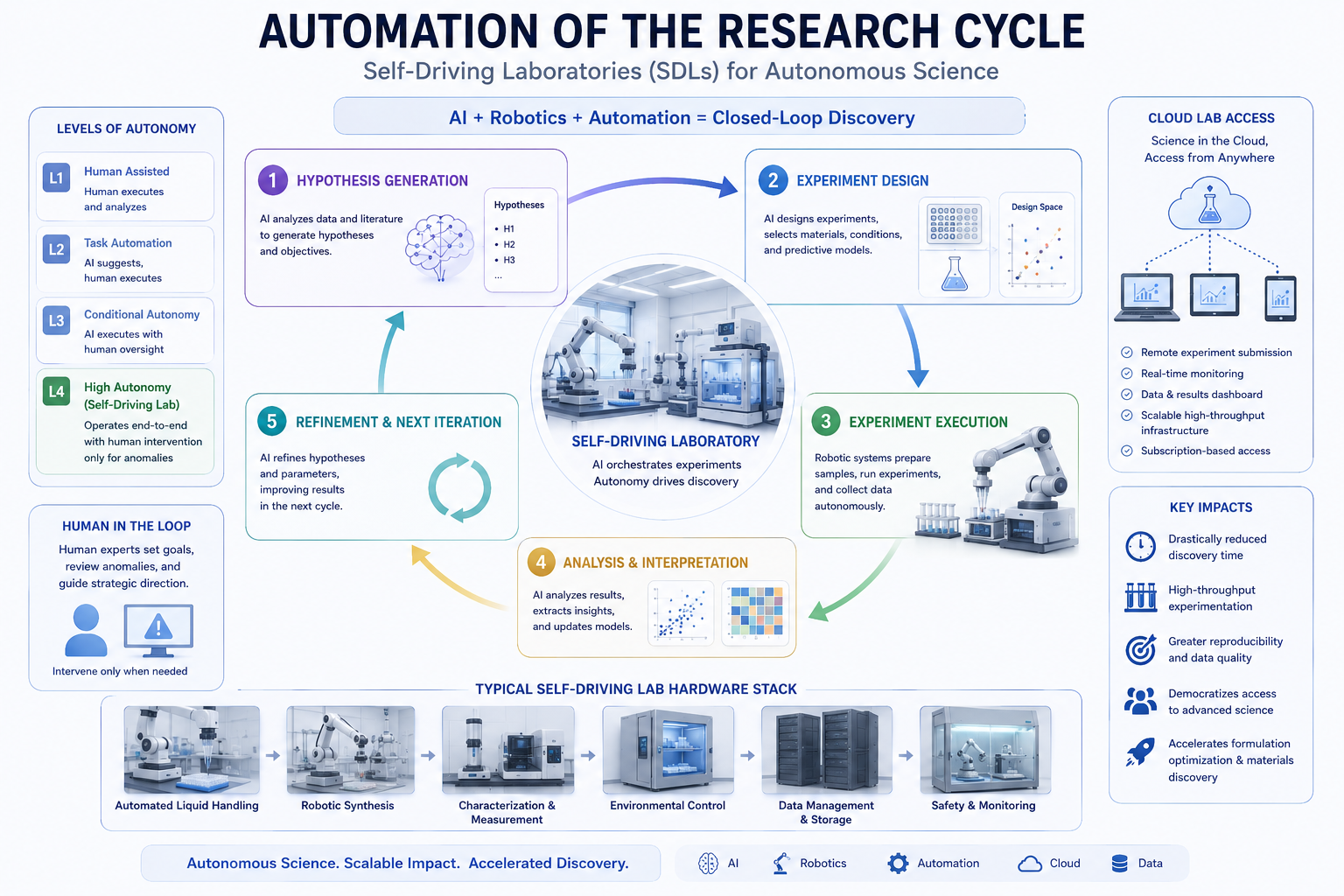
Self-driving laboratories (SDLs) integrate AI with robotic hardware to execute closed-loop experimentation: hypothesis, design, execution, analysis, and refinement. SDLs at Level 4 autonomy can operate with only human intervention for anomalies, while cloud labs offer subscription-based remote access — democratizing high-throughput science for smaller organizations. These platforms drastically reduce the time needed for formulation optimization and materials discovery.
Knowledge Synthesis and Decision Support
Automated literature synthesis and meta-analysis tools digest thousands of papers into actionable summaries, keeping researchers current without manual effort. LLM-based writing assistants aid in drafting grants and manuscripts, while literature mining pipelines extract structured data from the biomedical corpus — supporting competitive intelligence and hypothesis validation.
Interpretability and Trust
As AI becomes integral to discovery, explainable AI (XAI) and model interpretability are critical. In regulated domains, models must justify their predictions — for instance, explaining which molecular features drive a predicted ADME/T outcome. This transparency aligns with emerging governance regimes that demand reproducibility and auditability.
Collaborative and Privacy-Preserving Learning
Federated learning enables multiple institutions to collaboratively train models without sharing raw data — a powerful solution when dealing with proprietary formulations or sensitive patient data. This approach, combined with transfer learning, allows models pre-trained on human biomedical data to be fine-tuned for veterinary or agricultural contexts, even when local datasets are sparse.
Predictive Modeling at Scale
Classical and deep learning methods — CNNs, RNNs, graph neural networks, and transformers — are routinely applied to virtual screening, drug-target interaction prediction, and pharmacokinetic modeling. These techniques dramatically reduce the experimental burden and guide wet-lab efforts toward the most promising candidates.
The Converging Horizon
The distinction between exploration and empowerment is increasingly blurred. Agentic systems that propose novel hypotheses also orchestrate the experiments to test them. A self-driving lab might autonomously discover a new bioactive and simultaneously validate its safety profile.
For life sciences broadly — and for specialized fields like animal health — this convergence means faster breakthroughs, lower costs, and more rigorous science, provided we address the persistent challenges of transparency, data bias, and ethical oversight.