pH-Responsive versus Lipid-Based Microencapsulation for Post‑Ruminal Delivery of Feed Additives in Ruminants
The rumen – the first compartment of the ruminant stomach – is a highly fermentative environment populated by a dense consortium of bacteria, protozoa, fungi, and archaea. While advantageous for fibre digestion, this microbial activity also degrades or transforms many bioactive feed additives before they can reach the lower gastrointestinal tract. Essential oils, exogenous enzymes, probiotics, organic acids, and certain lipids are rendered ineffective by ruminal pH (≈ 6–7), enzymatic attack, and microbial metabolism.
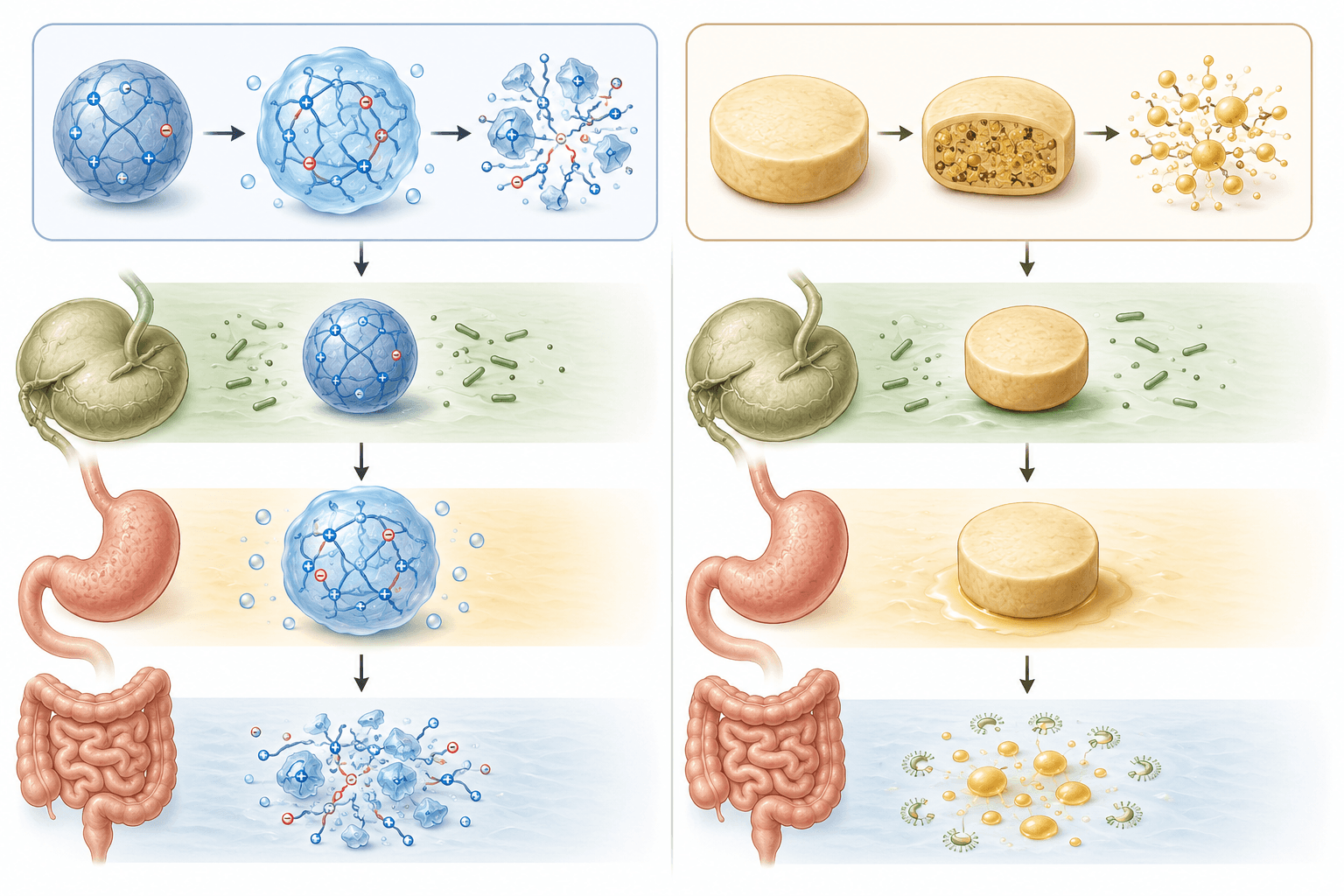
The rumen – the first compartment of the ruminant stomach – is a highly fermentative environment populated by a dense consortium of bacteria, protozoa, fungi, and archaea. While advantageous for fibre digestion, this microbial activity also degrades or transforms many bioactive feed additives before they can reach the lower gastrointestinal tract. Essential oils, exogenous enzymes, probiotics, organic acids, and certain lipids are rendered ineffective by ruminal pH (≈ 6–7), enzymatic attack, and microbial metabolism. Post‑ruminal delivery via microencapsulation has therefore become a central strategy to protect these compounds and enable their release in the abomasum (pH 1.5–2) or small intestine, where absorption or local action is desired.
Two fundamentally different encapsulation paradigms have emerged:
- pH‑responsive systems, which exploit changes in the ionization state of polymers to trigger swelling, dissolution, or bond cleavage in response to the pH gradient along the digestive tract.
- Lipid‑based systems, which rely on a hydrophobic, high‑melting‑point matrix that physically resists ruminal fluids but is intended to be digested in the abomasum or intestine.
2. Mechanisms of pH‑Responsive Encapsulation
pH‑responsive encapsulation exploits ionizable functional groups or acid‑labile covalent bonds to create a barrier that is stable under rumen conditions but disintegrates or becomes permeable when the pH drops in the abomasum (or rises again in the small intestine).
2.1 Protonation/Deprotonation and Swelling Behavior
Many pH‑responsive hydrogels contain weak acidic (e.g., –COOH) or basic (e.g., –NH₂) pendant groups. In the rumen's near‑neutral environment, the charge state of these groups determines whether the polymer network is collapsed (protecting the core) or swollen (allowing release).
- Polybasic (cationic) hydrogels swell at low pH and deswell at high pH. This makes them particularly suitable for abomasal release: the polymer remains compact in the rumen (pH > 6) and swells/dissolves in the acidic abomasum (pH 1.5–2).
- Polyacidic (anionic) hydrogels behave oppositely, swelling at high pH, and are more relevant for intestinal release after the abomasum, although they could be used if a secondary triggering factor (e.g., enzyme) is added.
2.2 Material Choices for Ruminant Applications
Materials investigated or proposed for pH‑responsive rumen‑bypass carriers include:
- Synthetic polymers: Eudragit‑type copolymers, poly(acrylic acid) (PAA) derivatives, and PVA‑based composites (often combined with lecithin or other stabilizers). PVA appears in several pH‑responsive hydrogel formulas, including those with graphene oxide or bacterial cellulose.
- Natural biopolymers: Alginate (with chitosan as a pore blocker), shellac, and oxidized starch. Alginate beads, however, show significant dry‑matter loss (42–54 % after 24 h) in ruminal fermentation, indicating the need for additional protective layers.
- Composite coatings: Combinations of pH‑responsive polymers with enzyme‑ or redox‑sensitive elements to achieve multi‑stimulus release.
3. Mechanisms of Lipid‑Based Encapsulation
Lipid‑based encapsulation creates a water‑insoluble, high‑melting‑point barrier that physically excludes aqueous rumen fluid and microbial enzymes.
3.1 Physical Barrier and Rumen Resistance
Typical lipid matrices consist of hydrogenated vegetable oils, triglycerides, or waxes. When processed into microcapsules (via spray drying, fluidised bed, or prilling), the lipid shell remains solid and impermeable at rumen temperatures (38–40 °C) and resists microbial colonization.
3.2 Digestibility and Bioavailability Constraints
The dense, crystalline network of hydrogenated fats resists enzymatic breakdown in the small intestine. Pancreatic lipase activity is limited by the matrix's high melting point and crystalline polymorph, leading to incomplete release and absorption of the encapsulated core.
Material and Process Options
- Hydrogenated vegetable oils (e.g., fully hydrogenated palm or soybean oil) combined with calcium carbonate and starch as fillers.
- Triglyceride matrices used in monogastric applications (e.g., a blend of thymol, vanillin, eugenol, and organic acids for weaned piglets). Although not tested in ruminants, such formulations demonstrate that lipid matrices can protect volatile oils and allow release in the lower gut in the absence of a rumen.
- Spray‑drying of lipid‑rich emulsions, the most common industrial method for rumen‑protected fats.
- Nanoemulsions and solid lipid nanoparticles that incorporate oil droplets within a lipid shell.
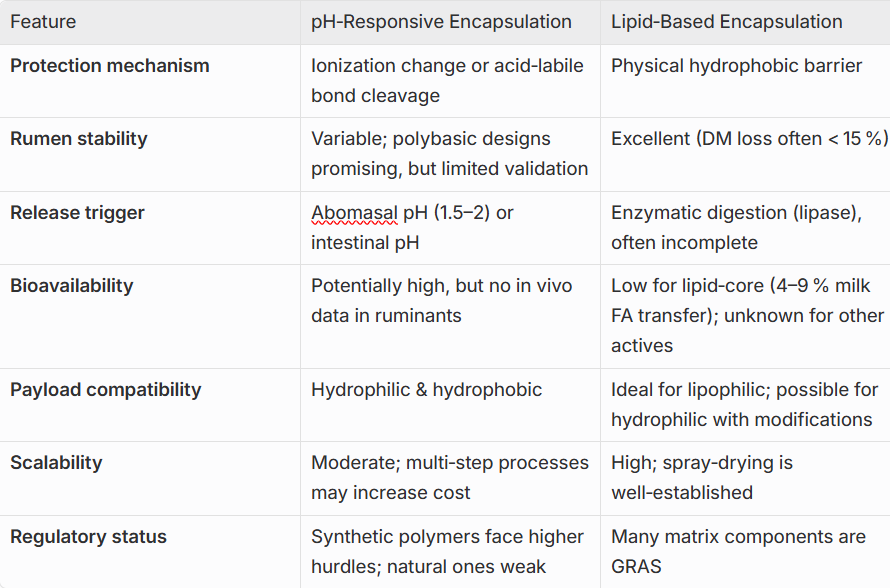
4. Comparative Analysis